Orange Blossom Beekeepers Association is hosting the 91st Annual Florida State Beekeepers Association Convention October 27-29, 2011. The event will be held at the Orange County Extension Offices located at 6021 S. Conway Road, Orlando, Florida.
The kick-off event will be a BBQ on Thursday October 27, beginning at 6:00 p.m., catered by Metro Catering. The BBQ will be at the Extension Offices location. The convention begins Friday the 28th at 8:30 a.m. with exciting speakers, presentations and a cooking demonstration by the 2011 Florida Honey Queen, Jayla Gillaspie.
A first ever presentation of "Queen of the Sun" will be shown in the auditorium (go to http://www.queenofthesun.com/about/story for more info about this great movie). A box/bag lunch will be provided and vegetarian sandwiches provided only if you check the appropriate box on the registration form. The cost of the convention is $25.00 per person. This includes the "Queen of the Sun" movie showing as well as the "A Day in the Bee Yard" event on Saturday.
As the "Queen of the Sun" movie is a special one-time only showing, members of the public are cordially invited to come view it. The cost for non-registered guests is $5.00 for the movie only
The Annual Banquet and auction will be held Friday night at the Holiday Inn International Airport, 5750 T.G. Lee Boulevard, Orlando, FL 32822. A "Taste of Italy" menu is planned, with vegetarian items included. Cost per person for the banquet is $40.00. The auction will include the entries from the Welsh Honey Show and Judging which will take place earlier in the day Friday. A special room rate of $81.00 will be provided. Let the reservations person know you are with FSBA when making your reservation for the special rate. call 407-851-6400 for reservations.
Read more here at Orange Blossom Beekeepers site
We are lifetime members at Orange Blossom Beekeepers and will be performing volunteer duties to help make this a GREAT Annual Convention!
Richard Martyniak

Bee Removals, Honey Bees, Killer Bees ,Yellow Jackets and other stinging insects in Florida.
Wednesday, September 28, 2011


Tuesday, September 20, 2011
But I Know these bees aren't Africanized Killer Bees !
I'm amazed at folks who insist that honey bees are always gentle, and sting only when provoked by significant provocation. While it's largely true that our managed honey bee colonies, those that we keep in our white bee hive boxes, don't sting en-masse while we work them properly, feral or wild honey bee colonies can be extremely variable in defensive response. Throw in the Africanized Honey Bee (Killer Bee) genetics that we are seeing all over Central Florida, and the defensive responses are hiking up to sometimes dangerous levels.
We inspect many feral honey bee colonies per day, some gentle, some mean as fire. And then there are those that seem to have some crazies. Take this Maitland bee removal we inspected yesterday. The nest is located above the first story roof line, normally a distance where the bees would hardly notice and certainly not care about a couple humans standing down in the yard.
While talking with the client, a guard bee came down to inspect us, and the client waved her hand (note, NEVER wave your hands at bees, they think it's a provocative act, akin to throwing the handkerchief on the ground), and BAP, the rogue guard bee stung our trainee technician in his Eyelid.
Still the client insisted that there was no way that these were Africanized Killer Bees! (To be fair, we can't ID bees as killer bees or European gentle honey bees until we perform a lengthy lab test involving several dozen sample bees, so we can't say what subspecies they are or aren't either).
No Big deal, right? we pulled out the stinger promptly, administered anthi-histimanes and ice per protocol. The next day, this is what our tech awoke to:
Sexy, eh? While it may look scary, the swelling is actually normal, as fluids tend to accumulate during sleeping and can't properly drain. However, this is not something we encourage our staff to endure. It's our protocol to assume every feral honey bee colony has the capacity to inflict multiple stings within seconds, and that's why are to wear hats on every call...Right Jeff? :-)
And while we may laugh this off, one sting can prove fatal to a sting-sensitive individual. We know of multiple incidents where folks have died from a single, or a few stings from bees or wasps. Couple that with the significant spike in mean Africanized Killer Bee feral colonies we see in homes, manufactured homes, trees and other locations, it's high time to take these bees serious, and to give them the respect due.
Richard Martyniak, M.Sc., Entomologist and Fla. Registered Beekeeper
The Buzzkillers, LLC
ALLFloridaBeeRemoval.com
 |
| Maitland Honey Bee colony located in porch floor |
 |
| Right EyeLid swelling 30 minutes after Bee Sting |
While talking with the client, a guard bee came down to inspect us, and the client waved her hand (note, NEVER wave your hands at bees, they think it's a provocative act, akin to throwing the handkerchief on the ground), and BAP, the rogue guard bee stung our trainee technician in his Eyelid.
Still the client insisted that there was no way that these were Africanized Killer Bees! (To be fair, we can't ID bees as killer bees or European gentle honey bees until we perform a lengthy lab test involving several dozen sample bees, so we can't say what subspecies they are or aren't either).
 |
| Right Eyelid swelling 30 minutes after bee sting |
No Big deal, right? we pulled out the stinger promptly, administered anthi-histimanes and ice per protocol. The next day, this is what our tech awoke to:
 |
| Right facial swelling prox 18 hours post bee sting |
Sexy, eh? While it may look scary, the swelling is actually normal, as fluids tend to accumulate during sleeping and can't properly drain. However, this is not something we encourage our staff to endure. It's our protocol to assume every feral honey bee colony has the capacity to inflict multiple stings within seconds, and that's why are to wear hats on every call...Right Jeff? :-)
And while we may laugh this off, one sting can prove fatal to a sting-sensitive individual. We know of multiple incidents where folks have died from a single, or a few stings from bees or wasps. Couple that with the significant spike in mean Africanized Killer Bee feral colonies we see in homes, manufactured homes, trees and other locations, it's high time to take these bees serious, and to give them the respect due.
Richard Martyniak, M.Sc., Entomologist and Fla. Registered Beekeeper
The Buzzkillers, LLC
ALLFloridaBeeRemoval.com
Thursday, July 28, 2011
Shoulda called the Stinging Insect Experts First!
This Jacksonville bee removal client had finally had enough with standard pest control providers. Every year, bees return to the block wall of her building, and every year her pest control operator would perform what we call a "spray & pray", just squirting some insecticide 'juice' where the bees were entering, charge her a couple hundred dollars and go on his way. The following year, bees return and the process starts anew.
After spending lots of dough, she finally searched for a true bee control expert, found us and her problem is solved.... permanently!!
Here's a pic of the site:
 The red arrows are where the bees were entering, and the white outline represents the size of the nest, located within the block wall voids.. a truly mature bee nest! We performed our DTS protocol, and saved her thousands of dollars.
Another satisfied client!
Contact us at 1-800-343-5317 or online here
Richard Martyniak, M.Sc., Entomologist
The Buzzkillers, LLC
ALLFloridaBeeRemoval.com
After spending lots of dough, she finally searched for a true bee control expert, found us and her problem is solved.... permanently!!
Here's a pic of the site:

Another satisfied client!
Contact us at 1-800-343-5317 or online here
Richard Martyniak, M.Sc., Entomologist
The Buzzkillers, LLC
ALLFloridaBeeRemoval.com
Wednesday, July 6, 2011
Need FREE Bee Removal? We are looking for HUGE Killer Bees & Yellow Jacket nests
Need FREE Bee Removal?
****** 13 JULY 2011: This offer has EXPIRED, We have filled our available free removal slots. Please stay tuned for further offers******
5 July 2011: Yep, the stinging insect scientists here at ALLFloridaBeeRemoval.com are conducting another research promotional project and are in need of a select few Killer Bee nests & Yellow Jacket nests!
The protocol requires the following conditions:
- Nest size must be above average, at least 6 months old and weighing in at least 50 pounds
- The bees have to exhibit an above average defensive posture. We prefer colonies that have already stung humans or pets and continue to sting or harass victims or potential victims.
- Geographical area is limited to Greater Tampa/St. Pete to Orlando to Northern Brevard County. We also will consider Orlando North to Belleview, especially around the Villages as we have been encountering extremely defensive bees this year.
- We will consider Exceptional colonies in other areas of the state. Contact us at 1-800-343-5317 or info@allfloridabeeremoval.com to discuss your special nest!
Here are some photos of some infestations that might qualify for the protocol:
 |
| Orlando, FL: Perennial Honey Bee colony in Building Wall. |
 |
| Oxford Fl. (The Villages): Africanized Honey Bees (Killer Bees) cleaning around the nest opening, which is located at the electrical penetration. Killer Bees often build nests in concrete block wall voids. These colonies can become extremely defensive and are a serious sting risk to pets and humans. |
 |
| The Villages, FL: Africanized (Killer Bees) Honey Bee colony located in widow's walk above roof of 3 story structure. The Bees were very defensive, threatening public over 300 feet away. Rotting, fermenting honey was found dripping into executive offices, after a pest control application. With larger nests, one must remove the colony or problems will escalate |
 |
| Tallahassee FL: Perennial Honey Bee colony in wall of rental house. This colony weighed out at over 100 pounds. Bees had been finding their way into the living area of the home and threatening sting sensitive residents. At least 2-3% of the general population are so allergic to bee venom, that one's breathing could stop within minutes..after only one sting! |
 |
| West Ocala,, Marion County, Fl: Honey Bee 'External' nest constructed under eave of residential home. Residents thought this was only a swarm..a temporary group of bees.. but during removal we found substantial wax comb, indicating that the colony was at least 4-6 weeks old, old enough for a defensive manner to develop. Improper removals of these external honey bee colonies can threaten nearby pets and animals. |
 |
| South Orange County (Orlando), FL: Very large, well established Africanized Honey Bee colony located between floors in an apartment building. Management company wanted us to perform a live bee relocation, but these bees were extremely defensive, posing a significant threat to residents, neighbors and pets. |
 |
| Jacksonville, Fl: Typical of what we find after a cheap 'drive-by' treatment from a well meaning pest control operator. At the top is a healthy honey bee colony, probably 4-5 weeks old, busily expanding it's nest in this master bedroom wall. The dark area at the bottom is an earlier honey bee colony that was treated succesfully...and then left to ROT in this wall. A travesty that a pest control operator charged a couple hundred dollars to perform. tsk. tsk. |
 |
| Jacksonville, FL: This is a closeup of the dead, rotting, fermenting honey bee colony seen in the picture above. This organic material is decaying, aided my thousands of MAGGOTS eating, defecating, and spreading fungi and bacteria throughout the rotting mess. This is a product of CHEAP DRIVE-BY BEE TREATMENTS and could be avoided by hiring stinging insect experts such as ourselves. Leaving this mess would only attract other mean robber bees, flies, beetles and more maggots, which spread throughout the house on a quest we call the MAGGOT MARCH. |
 |
| Longwood, FL: A national pest control company sprayed a client's bee colony, not once..not twice, but 5 different times to finally kill the Killer Bee Colony located in a porch portico. |
 |
| Longwood, FL: Closeup of the mass of maggots, maggot feces and other organic waste found at the bottom of the infested portico porch column from the picture above. |
 |
| Ponte Vedra, FL: Honey bee Colony infested a void located above a dormer window. This Plantation Golf Club house, required 2 technicians a full day to remove over 200 pounds of honey, pollen and bees from this void. A national animal trapping company had tried, unsuccessfully, to eradicate the colony and just leave it in place. Luckily for the homeowner, the bees persisted, because of the animal control technician's ineptitude. |
 |
| Tampa Fl: Killer Bees infest a void above a kitchen ceiling. We are seeing a large increase in the number and ferocity of bees in the Central Florida Area. We also are seeing an increase in the number of bee removal folks that are preying on innocent homeowners, as these shysters are not licensed as pest control operators. Please, make sure your provider has the bare minimum of a PCO license in order to protect you and your assets! |
 |
| Jacksonville, FL : Honey Bee colony located above a dining room ceiling. This client finally called us after 2 pest control companies failed to curb an ongoing bee infestation. He spent over $600 needlessly.... |
 |
| Port Orange, FL: Yet another Africanized Honey Bee (Killer Bee) infestation located above a ceiling. Bees often will build in these areas, and you certainly don't want to just leave them here. |
 |
| Fernandina Beach, FL: Honey Bees in a garage wall. The local Electric Utility used wasp spray on this colony and made the surviving bees very mad. A sting incident was averted when the client called ALLFloridaBeeRemoval.com |
 |
| Winter Springs, FL: The city has entomologist Richard Martyniak remove suspected Africanized Honey Bee (Killer Bee) colonies such as this bee-utiful external colony. Many cities, counties and utilities trust the entomologists at ALLFloridaBeeRemoval.com to protect their citizens, staff and clients! |
****** 13 JULY 2011: This offer has EXPIRED, We have filled our available free removal slots. Please stay tuned for further offers******
Monday, March 14, 2011
Honey Bees in House Walls, Eaves and Columns
It's springtime in Florida, and that means we are getting loads of calls for swarming honey bees! Swarms can be very frightening to folks who've never had experience working with honey bees, but in reality are not *usually* very much of a threat as they have no nest to defend.
A swarm occurs when a bee colony outgrows it's nesting area. This happens usually, when nectar and pollen sources from flowers become abundant, (springtime flowering), and the queen starts laying up to 2,000 eggs a day. At some point, about half the colony will leave, looking for a new location to build a new nest, while leaving the old nest to rebuild it's numbers.
This new swarm will typically land for a few hours, somewhere near the mother colony. We usually advise clients to leave the swarm alone, keep pets and people away, and the swarm will move on, without harming a thing.
But, when these swarms alight on house walls, eaves or other structural elements, it's best to give us a call for proper removal, as they often will move into wall voids, eave voids and just about anywhere else, often putting away hundreds of pounds of honey, pollen and wax withing the wall. Please do not try to self treat these swarms, as bad things can happen!
For proper honey bee swarm removal, Call us at 1-800-343-5317
Richard Martyniak, M.Sc., Entomologist
ALLFloridaBeeRemoval.com
 |
| Clermont Honey Bee swarm on Tree |
A swarm occurs when a bee colony outgrows it's nesting area. This happens usually, when nectar and pollen sources from flowers become abundant, (springtime flowering), and the queen starts laying up to 2,000 eggs a day. At some point, about half the colony will leave, looking for a new location to build a new nest, while leaving the old nest to rebuild it's numbers.
 |
| Orlando Honey Bee swarm on building wall |
This new swarm will typically land for a few hours, somewhere near the mother colony. We usually advise clients to leave the swarm alone, keep pets and people away, and the swarm will move on, without harming a thing.
 |
| Longwood Bee Swarm on Block Wall |
But, when these swarms alight on house walls, eaves or other structural elements, it's best to give us a call for proper removal, as they often will move into wall voids, eave voids and just about anywhere else, often putting away hundreds of pounds of honey, pollen and wax withing the wall. Please do not try to self treat these swarms, as bad things can happen!
 |
| Apopka Bee Colony in wall |
For proper honey bee swarm removal, Call us at 1-800-343-5317
Richard Martyniak, M.Sc., Entomologist
ALLFloridaBeeRemoval.com
Tuesday, December 21, 2010
Looking for that last minute holiday gift? Give the gift of Honey Bees!
Are you doing some last minute Christmas or Holiday gift shopping?
Have someone on your list who already has everything? Don't know where to turn?
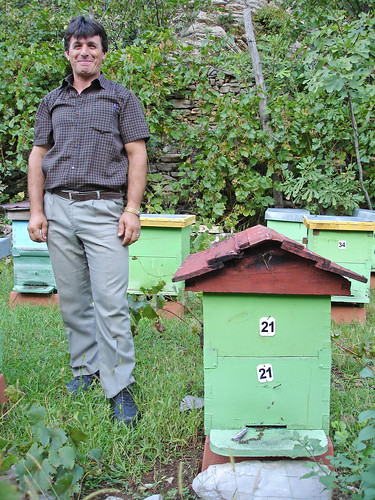
Here's the idea: You purchase a share of honey bees for needy small scale farmers in places such as Africa or Central and South America, and donate them in the name of your gift recipient. Honey Bee cultivation requires very little space, provide a rich sugar source, and can provide needed income for struggling families. And you don't even need to know a thing about honey bees, as there are reputable aid organizations that handle everything. Oxfam and Heifer.org are 2 organizations that we here at http://ALLFloridaBeeRemoval.com support.
For as little as $18, you can help a family become self sufficient. Go here to check them out:
Heifer.org honey bee gift page:
Heifer.org honey bee donation page

Oxfam America Honey Bee Gift page

(oxfam site appears to be down..hope it comes back!)
Happy Holidays
Richard Martyniak
Monday, November 1, 2010
A reader asks: "Where can I see a copy of Florida's bee removal regulation?
Dear Cindy,
In Florida there is no "Bee Removal Regulation", per se.
Honey Bee colony removal from structures or landscapes in Florida is considered to be pest control, and as such, is regulated by Fla. State Statutes 482 & 5E-14. Here's a link to Ch 482.
Briefly, Ch 482 requires that one must possess a current pest control license to inspect for, remove, eradicate, or otherwise mitigate honey bee colonies in or around structures or landscapes. Here are some of the important parts of the statute, defining pest control:
(21)
“Pest” means an arthropod, wood-destroying organism, rodent, or other obnoxious or undesirable living plant or animal organism.
(22)
“Pest control” includes:
(a)
The use of ANY method or device or the application of any substance to prevent, destroy, repel, mitigate, curb, control, or eradicate any pest in, on, or under a structure, lawn, or ornamental;
(b)
The identification of or inspection for infestations or infections in, on, or under a structure, lawn, or ornamental;
(c)
The use of any pesticide, economic poison, or mechanical device for preventing, controlling, eradicating, identifying, inspecting for, mitigating, diminishing, or curtailing insects, vermin, rodents, pest birds, bats, or other pests in, on, or under a structure, lawn, or ornamental;
So, the above definition clearly states that honey bees, in and around structures are considered pests, and also includes nearly any activity intended to solve a pest honey bee infestation as pest control.
Or in other words, a beekeeper,in the process of removing a colony of pest honey bees from a structure or landscape, is performing pest control!
Just arriving and identifying the insect colony as Honey Bees, Yellow Jackets, or whatever, is pest control. And because mechanical devices are included in the pest control statute definition, once one uses common beekeeping tools such as bee vacuums, bee brushes, sugar water sprays, smokers, hive tools and the myriad of other tools commonly used in bee removals, he or she has ventured far into pest control, as clearly defined by State Statute.
So how does one perform bee removal legally here in the state of Florida? Well, one must work for a licensed pest control firm. That means that one is trained by the firm's Certified Pest Operator, is paid salary by the firm, drives that firm's truck, uses the firm's tools, equipment and supplies, and is covered by the commercial insurances including liability and workmen's compensation.
And, in order to secure and maintain a pest control license, one must pass several hurdles: Work under a Certified pest control operator for 3 years as a licensed technician; pass a certification exam; Maintain minimum business liability insurance; take annual Certified Educational Units, (CEU's); and maintain annual operator & business licenses, which are administered by the Bureau of Entomology and Pest Control. Oh, and one cannot be a convicted felon! The Bureau has authority to fine, remove license privileges and arrest violators and illegal operators, all of which affords the State's citizens significant protections.
What are the penalties for performing illegalbee removal Pest Control?
So, you see that the State takes this very seriously. And, don't you think you should too? Do you Really want someone servicing your home that doesn't care about the law??? I certainly am very careful about who I let in my home!!! You should bee too!!
The Bureau of Entomology and Pest Control has a page that summarizes the legaleze very well. See it here. To check your bee removal provider's pest control certification status, you can go to this Bureau site here. Click on the "applicators" button to check on individuals, or on the "companies" button to check the status of firms.
If you witness unlicensed pest control, you can report it to your state inspector ( go here to find your region's inspector), or fill out this complaint form and send it to the address included within.
And, in order to secure and maintain a pest control license, one must pass several hurdles: Work under a Certified pest control operator for 3 years as a licensed technician; pass a certification exam; Maintain minimum business liability insurance; take annual Certified Educational Units, (CEU's); and maintain annual operator & business licenses, which are administered by the Bureau of Entomology and Pest Control. Oh, and one cannot be a convicted felon! The Bureau has authority to fine, remove license privileges and arrest violators and illegal operators, all of which affords the State's citizens significant protections.
What are the penalties for performing illegal
(1) It is unlawful to solicit, practice, perform, or advertise in pest control except as provided by this chapter.
(2) A person who violates any provision of this chapter is guilty of a misdemeanor of the second degree, punishable as provided in s. 775.082 or s. 775.083.
So, you see that the State takes this very seriously. And, don't you think you should too? Do you Really want someone servicing your home that doesn't care about the law??? I certainly am very careful about who I let in my home!!! You should bee too!!
The Bureau of Entomology and Pest Control has a page that summarizes the legaleze very well. See it here. To check your bee removal provider's pest control certification status, you can go to this Bureau site here. Click on the "applicators" button to check on individuals, or on the "companies" button to check the status of firms.
If you witness unlicensed pest control, you can report it to your state inspector ( go here to find your region's inspector), or fill out this complaint form and send it to the address included within.
As you can see, there are no exemptions for beekeepers that do not possess a pest control license, to allow honey bee removals. In fact, the Chief Apiarist for the State of Florida's Department of Agriculture does not recommend live removals of any kind in or near structures, and only recommends that trained, licensed pest control operators eradicate pest honey bee colonies that are found near people or pets. Why? Primarily because of the Public health risk from Africanized Honey Bees. This race of Honey Bee is spreading further and further throughout the State and can cause serious injury or death because of it's super-defensiveness.
Beekeeping IS regulated by State Statute, however, the intent of these beekeeping regulations is to prevent spread of bee disease and unwanted subspecies of honey bees, NOT to protect humans!.
The keeping of honey bees or the transport of such insects, is regulated by Fla. State Statute Ch. 586. Note that this statute does not regulate bee removals, as bee removal is considered pest control and regulated by Ch. 482 & 5E-14.
Beekeepers only have to complete a registration process, submit to one annual inspection and pay a small fee. There are no beekeeping certification processes, no minimum insurances required, no annual CEU requirements or any other requirements under beekeeping regulations to protect the citizens of Florida against improper bee removals. Should a citizen suffer structural damages, physical injury or death resulting from a beekeeper-removal bee sting incident, there are no protections afforded, and lawsuit would be the only means of remedy. Little solace indeed, if the provider has few or no assets.
So, if one is performing bee colony removals in the State of Florida, and does not possess a valid pest control license, that person is performing illegally, according to Florida State Statute. Possession of a Beekeeping Registration does not grant license to perform bee colony removals, no matter what beekeepers may tell you, wish, or otherwise desire.
We possess the certifications, registrations, insurances, experience and education required to perform proper stinging insect removals in the State of Florida. Call us at 800-343-5317 or visit our website at http://ALLFloridaBeeRemoval.com .
I hope this helps. Please let me know if I can be of further assistance.
Richard Martyniak, M.Sc., Entomologist
ALLFloridaBeeRemoval.com
The Buzzkillers, LLC
1-800-343-5317 -or- 321-206-5100
Email me!
Subscribe to:
Posts (Atom)